
Stock Labels Versus Custom Labels: Which Fits?
A label that peels off in a cold warehouse, smears after a chemical splash, or will not scan at receiving is not a minor supply issue. It can delay shipments, compromise traceability, and create costly rework. The choice between stock labels versus custom labels should be based on the demands of the application, not just the unit price on a box.
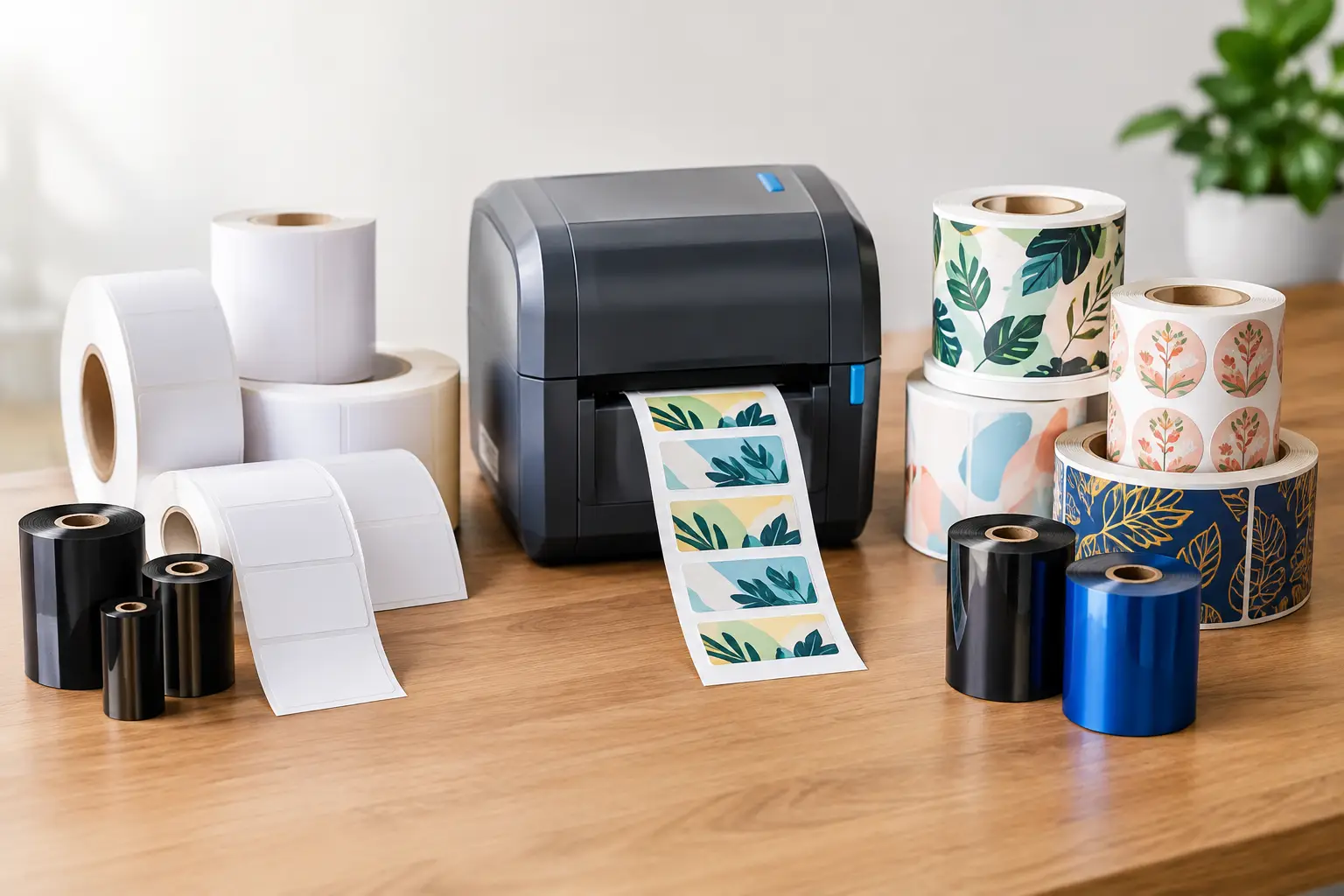
Stock labels are often the right answer for common, stable labeling jobs. Custom labels become the better investment when label size, material, adhesive, compliance language, or branding must be exact. The practical question is not which option is universally better. It is which one gives your operation dependable print quality, barcode readability, and the lowest total cost of ownership.
What Stock Labels Do Well
Stock labels are pre-manufactured in standard sizes, materials, colors, and adhesive configurations. Because they are produced in volume and readily available, they are usually the fastest and most economical choice for everyday applications such as shipping labels, inventory tags, carton identification, bin labels, barcode labels, and general product marking.
For many warehouse and distribution operations, standard direct thermal or thermal transfer labels cover the job well. A common 4-by-6-inch shipping label, for example, does not need a special die or a unique material specification when it will be applied to corrugated cartons and used through a normal delivery cycle. Choosing a stock format keeps procurement simple and helps teams replenish supplies quickly.
Stock labels also make sense when your label layout may change frequently. If a facility is testing a new barcode format, revising a pick-label process, or adding fields to a shipping label, standard blank labels allow the design to change in software without scrapping a custom preprinted inventory. EasyLabel is particularly useful in this situation because users can create, revise, and print operational labels without a recurring software subscription or required support contract.
The limitation is that “standard” only works when the environment is standard. A label designed for dry indoor carton labeling may not stay in place on a dusty plastic tote, survive freezer temperatures, or remain legible on an oily metal part. Stock materials offer useful choices, but they cannot address every operating condition or every dimensional requirement.
When Custom Labels Earn Their Cost
Custom labels are manufactured to your specifications. That can include the exact width and height, die-cut shape, face stock, adhesive, liner, color, preprinted graphics, sequential numbering, and perforation pattern. Customization is not merely about appearance. It is often the difference between a label that performs consistently and one that creates an ongoing operations problem.
A manufacturer applying labels to curved containers may need a smaller format or flexible material that conforms without flagging at the edges. A food processor may require an adhesive that holds in refrigerated or frozen storage. A chemical or industrial operation may need a synthetic face stock and ribbon combination that withstands abrasion, moisture, or exposure to solvents. In each case, a custom label specification can reduce replacement labeling, scanning failures, and product identification errors.
Custom labels are also appropriate when labels need to carry fixed information before they enter your printer. Company logos, safety colors, handling instructions, regulatory text, and branded product information can be preprinted, while variable information such as lot numbers, dates, weights, and barcodes is printed on demand. This approach can improve consistency and reduce the amount of data that employees need to select manually at the printer.
The trade-off is lead time and commitment. Custom orders normally involve minimum quantities, approval of artwork or specifications, and a longer production cycle than off-the-shelf supplies. They are a poor fit for an unproven application or a label design that is likely to change next month. They are a strong fit when the application is established, volumes are meaningful, and the cost of failure is higher than the cost of specifying the right label.
Stock Labels Versus Custom Labels: Key Decision Factors
Start with the surface and the environment. Identify whether the label will be applied to corrugate, poly bags, painted metal, glass, plastic, drums, pallets, or another substrate. Then account for temperature, moisture, oils, UV exposure, abrasion, and the expected service life. These factors determine whether paper is sufficient or whether a synthetic material and specialized adhesive are necessary.
Next, consider label dimensions and printer compatibility. A stock label that is close to the desired size can waste space, limit barcode size, or force an awkward layout. On the other hand, a custom size that is too narrow for a high-density barcode can create scan problems. Barcode labels need adequate quiet zones, suitable contrast, and a print resolution that supports the chosen symbology. The label, ribbon, printer, and software must work as a system.
Cost should be evaluated beyond the price per thousand labels. Stock labels generally carry lower upfront costs and reduce the risk of unused inventory. Custom labels can lower labor costs when they eliminate manual labeling steps or preprint information that would otherwise be entered at the workstation. A custom construction that prevents labels from falling off may protect far more value than it adds to the material cost.
Compliance is another deciding factor. Industries managing hazardous materials, food products, medical devices, laboratory samples, or regulated manufacturing processes may require specific label layouts, color coding, warnings, or durable identification. A generic stock label may be adequate only if it supports the required content and stays readable throughout the product’s handling and storage cycle.
Do Not Separate Labels From Print Technology
The wrong ribbon can undermine the right label. Thermal transfer labels require a ribbon matched to the face stock and the durability target. Wax ribbons are often appropriate for economical paper labeling, while wax-resin and resin ribbons provide increased resistance for demanding applications. Direct thermal materials remove the need for a ribbon, but they are generally best suited to shorter-life labels that are not exposed to excessive heat, light, or abrasion.
Printer selection matters just as much. A printer must handle the chosen media width, core size, label roll diameter, print speed, and resolution. For operations printing durable custom labels or dense barcodes, a dependable thermal transfer printer is usually a better long-term choice than trying to force a basic desktop device beyond its intended duty cycle.
Tharo thermal printers provide a cost-conscious option for businesses that need commercial-grade printing without paying flagship-model pricing. Their replacement printheads are generally less expensive than comparable competitor replacements, and 4-inch-wide 203 and 300 DPI H- and T-Series printers include a two-year or two-million-printed-inch warranty. The right equipment protects print quality while giving operations a more predictable maintenance cost.
A Practical Selection Process
Before buying a large quantity of either stock or custom labels, document the actual job. Measure the available labeling area, identify the application surface, define the required barcode type, and note the handling conditions from application through final use. If the label is used for shipping, test it through the real packing and transport process. If it is used for product identification, test scan performance at the distance and angle employees use on the floor.
For a standard indoor application, begin with a stock label sample in the correct material category and run it with the intended printer and ribbon. This is usually the quickest route to a proven solution. If it curls, smears, lifts, leaves inadequate room for required data, or creates excessive labor, move to a custom specification rather than accepting a workaround as normal.
For a custom project, specify the functional requirements before discussing colors or graphics. Material, adhesive, size, winding direction, core size, and printer settings affect whether the label will run efficiently. A label that looks correct on a proof but feeds poorly through the printer is not a successful label.
Buy the Labeling System, Not Just the Roll
Businesses often lose time by sourcing software, printers, labels, and ribbons from separate vendors, then trying to determine which supplier owns a print or scanning problem. A knowledgeable labeling supplier can help match consumables to the printer and application, reducing the guesswork that causes downtime.
The Label Guy supports that complete workflow, from EasyLabel design software and thermal printers to stock supplies, custom label requirements, and USA-based technical support. For buyers managing multiple facilities or recurring production needs, that specialist support can be more valuable than a small savings on an individual roll of labels.
Choose stock labels when the application is common, stable, and well served by standard sizes and materials. Choose custom labels when performance, compliance, workflow efficiency, or presentation depends on getting the specification right. The best label is the one employees can apply, print, scan, and trust without having to think about it again.