
Warehouse Bin Labels With Barcodes That Work
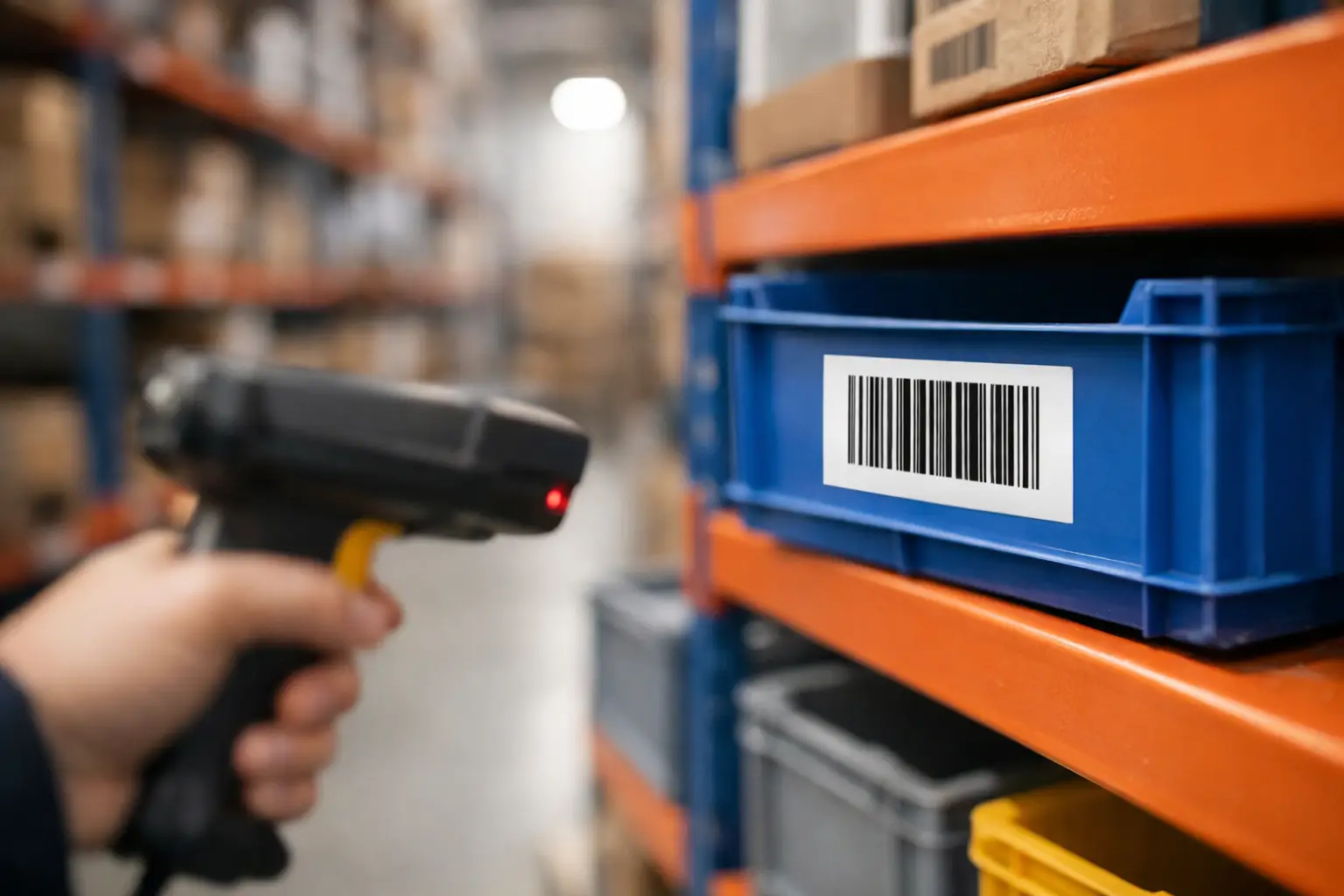
A picker loses 20 seconds hunting for the right location, and that small delay gets repeated hundreds of times a day. That is why warehouse bin labels with barcodes are not a minor supply decision. They directly affect scan accuracy, replenishment speed, cycle count quality, and how often your team has to stop and fix preventable errors.
Good bin labeling does two jobs at once. It gives people a clear visual location reference, and it gives your system a scannable data point that holds up under real warehouse conditions. When either side fails, operations feel it fast. Misscans increase, labels peel, forklift traffic knocks corners loose, and workers start keying in locations by hand.
Why warehouse bin labels with barcodes matter
In most warehouses, location labeling gets treated as a one-time setup task. In practice, it is part of the operating system. Every receiving putaway, replenishment move, pick confirmation, and count transaction depends on locations being easy to find and easy to scan.
A well-designed barcode bin label reduces hesitation. The worker sees the aisle, bay, level, and position clearly, scans once, and moves on. That sounds simple, but the gain adds up across every shift. Faster scans mean less time in front of the rack and fewer workarounds when a code will not read.
There is also a quality control benefit. If your warehouse management system is only as accurate as the locations feeding it, damaged or poorly printed labels create downstream inventory issues. A mislabeled slot can trigger bad picks, false shortages, and unnecessary recounts. The cost of a stronger label stock or a better print method is usually far lower than the cost of recurring location errors.
What makes a bin label actually work in a warehouse
Not every barcode label belongs in a warehouse. Office-grade labels may look fine on day one and fail quickly when exposed to abrasion, dust, temperature swings, and aggressive handling. A warehouse label has to match the environment, the rack or bin surface, and the way operators scan.
The first requirement is readability. Human-readable text should be large enough to spot at normal working distance, especially for upper rack levels or fast-moving pick faces. The barcode itself must be sized for the scanner type and scan distance. If the code is too small, too dense, or printed with weak contrast, your team will end up rescanning or manually entering locations.
The second requirement is durability. That includes the face stock, the adhesive, and the print technology. Paper labels can work in limited indoor applications, but many warehouse operations are better served by synthetic materials that resist tearing, moisture, and smudging. Thermal transfer printing is often the better choice when you need long-lasting location labels because the printed image holds up better than direct thermal in demanding environments.
The third requirement is placement. Even a high-quality barcode fails when it is mounted where pallet overhang, shrink wrap, or rack beams interfere with the scan path. Label design and label position need to be planned together.
Material and adhesive choices depend on the location
This is where many projects go wrong. Buyers focus on the barcode format and overlook the mounting surface. A smooth plastic tote, a powder-coated rack upright, and a dusty corrugated bin do not behave the same way.
For long-term rack labeling, polyester and other durable synthetic materials are often a safer choice than basic paper. They resist scuffing and tend to stay readable longer in high-contact areas. If labels will be exposed to cleaning chemicals, cold storage conditions, or repeated abrasion, material selection matters even more.
Adhesive also needs to match the job. Permanent adhesive is common for fixed rack locations, but removable options may make sense for temporary staging areas or re-slotting programs. On rough or low-energy surfaces, standard adhesive may not bond well enough. In those cases, using a more aggressive adhesive can prevent edge lift and early failure.
There is a trade-off. More aggressive adhesives improve staying power, but they can make future removal harder and may leave residue. If your layout changes often, it may be worth using placards, magnetic holders, or label protectors instead of applying permanent labels directly to every surface.
Barcode type, size, and print quality
The barcode on a bin label is not just a graphic. It is a data carrier that needs to be easy for your scanners to read under normal motion. Most warehouse location labels use linear barcodes because they are simple, familiar, and dependable for short location strings. In some operations, 2D codes are useful, but they are not automatically better for bin locations.
The right barcode symbology depends on your software, scanner fleet, and location naming structure. What matters most is consistency. If one section uses Code 128, another uses a different standard, and print quality varies by device, scanning reliability suffers.
Print resolution matters too. Small barcodes printed on low-resolution devices can create read problems, especially if the code is dense. That is why industrial thermal printers are typically a better fit than light-duty desktop equipment for high-volume warehouse identification work. Pair that printer with a ribbon and label stock that are designed to work together, and you get better edge definition and better long-term performance.
Software plays a bigger role than many teams expect. Label design platforms like EasyLabel help standardize formats, barcode rules, variable data, and printer output so labels remain consistent across sites and users. That reduces the risk of someone creating a location label template that looks fine on screen but performs poorly on the floor.
Designing labels for people, not just scanners
A warehouse location label should never rely on the barcode alone. Operators need clear text, logical formatting, and enough contrast to identify a slot quickly without pausing. If your location code is A-12-03-04, that full string should be easy to read at a glance.
Font choice, character size, and layout matter. Avoid crowding too much information into a small label. If your team needs zone, aisle, bay, and level information, present it in a way that mirrors how they navigate the warehouse. In some facilities, color can help distinguish zones or storage types, but color should support the label, not carry the whole burden of identification.
This is especially true in fast-pick environments. Workers are moving quickly, often from an angle, sometimes with partial obstruction. A label that is technically correct but visually weak will still slow them down.
Common mistakes with warehouse bin labels with barcodes
The most common mistake is buying labels as a commodity. Warehouses need a system, not just adhesive rectangles. If the printer, ribbon, software, and label stock are selected separately with no coordination, problems show up quickly.
Another mistake is underestimating the environment. Heat, cold, dust, moisture, and friction all change label performance. A label that survives in a clean stockroom may fail on an active warehouse rack face.
Poor standardization is another issue. If some labels are printed in-house, others are handwritten replacements, and others come from different templates, location control becomes inconsistent. Standard formats, approved materials, and controlled print settings prevent that drift.
Finally, many operations skip testing. Before rolling out hundreds or thousands of labels, test them on the actual rack, bin, or tote surface. Scan them from real working distances with the scanners your team already uses. It is far easier to correct label size or adhesive choice in a pilot than after a full installation.
Choosing a complete solution instead of piecing it together
For many businesses, the better approach is to source warehouse bin labels with barcodes as part of a complete labeling setup. That means the software, printer, ribbon, and label material are chosen to work together, with support available when settings or applications change.
That matters when your operation grows. A facility that starts with a few hundred locations can quickly expand into multiple zones, mobile printing needs, replacement labeling, and custom formats for cold storage, compliance, or inventory programs. Working with a specialist reduces guesswork and shortens the time between identifying a problem and fixing it.
The Label Guy supports that kind of end-to-end labeling environment, from software and thermal printers to ribbons, stock labels, and custom solutions for demanding applications. For operations teams, that means fewer compatibility issues and a clearer path from label design to reliable performance on the floor.
When custom bin labels make more sense
Stock label sizes cover many needs, but custom labels are often the better choice when racks, totes, shelves, or workflow requirements are unusual. If your scan distance is longer, your location code is complex, or your mounting area is limited, a custom format can solve those issues without forcing compromises.
Custom labels also make sense when branding, color-coding, serial control, or extra human-readable data needs to be built into the design. The goal is not complexity for its own sake. It is making sure the label fits the operation instead of forcing the operation to work around the label.
The best warehouse labels tend to be the ones nobody talks about after installation. They stay in place, scan the first time, and support the pace your team needs to keep. If your current location labels are failing, slowing picks, or creating avoidable inventory errors, that is usually a sign to revisit the full labeling system, not just reorder the same label again.