
Durable Labels for Outdoor Equipment That Last
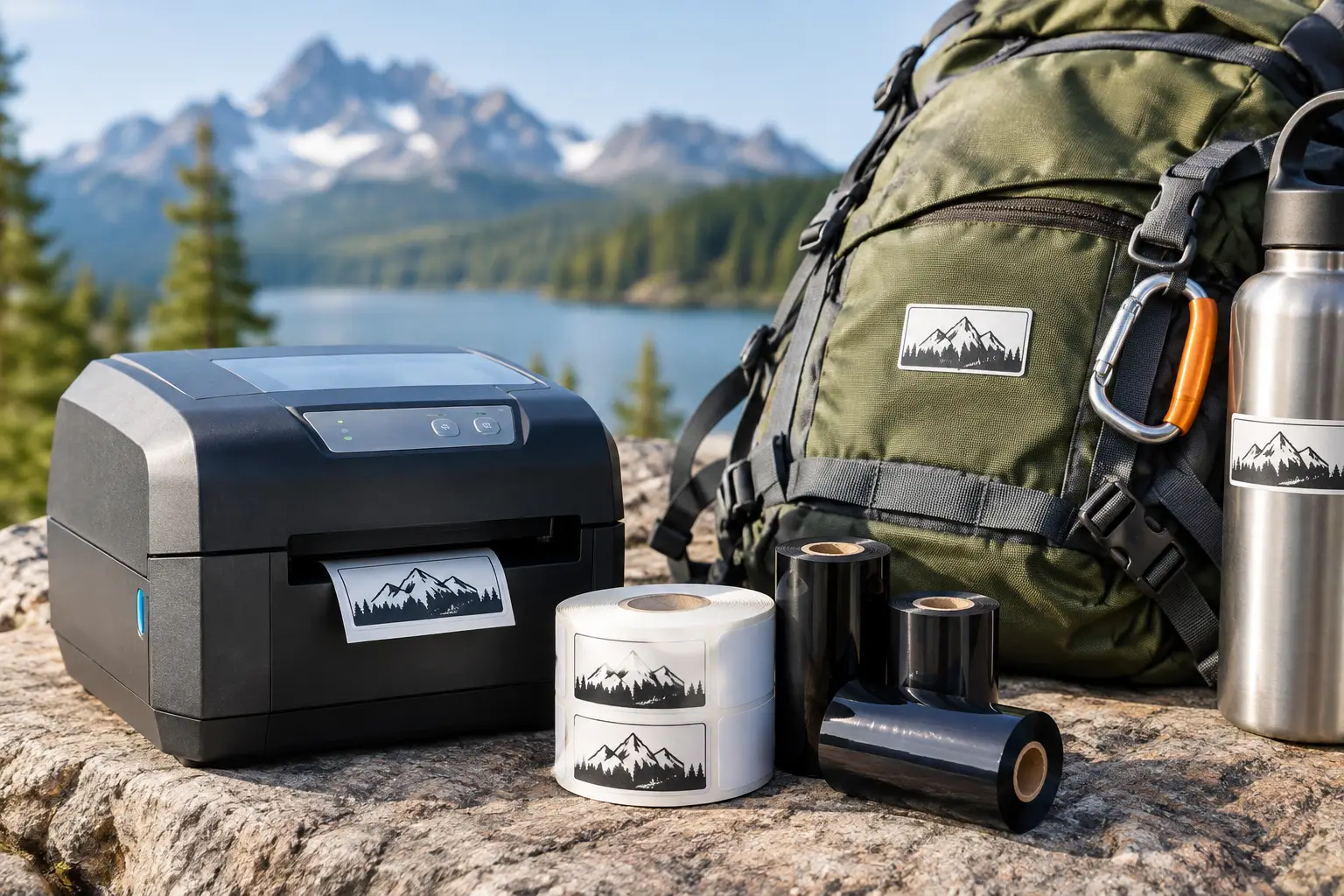
A faded equipment ID label is more than an appearance problem. When a barcode will not scan, a serial number cannot be read, or a safety instruction is missing, crews lose time and maintenance records become less reliable. Durable labels for outdoor equipment must keep their adhesive bond, printed information, and scan quality through conditions that quickly defeat ordinary paper labels.
For manufacturers, rental operations, utilities, construction firms, municipalities, and fleet managers, the right label is part of the equipment-control process. It helps identify assets at the point of use, supports inspection schedules, and provides traceability when equipment changes hands or returns for service. The label material, adhesive, ribbon, printer, and design process all have to match the job.
What Outdoor Equipment Labels Must Survive
Outdoor exposure is rarely one problem at a time. A compact loader may sit in direct sun, get washed down, collect dust, and be handled with dirty gloves during the same shift. A label on a generator or utility enclosure can face fuel splashes, vibration, heat, winter temperatures, and repeated abrasion from tools or cables.
Ultraviolet light is a common cause of failure. It can fade ink and weaken many materials over time, especially on labels placed horizontally or on sun-facing surfaces. Moisture is equally demanding. Rain, humidity, pressure washing, and condensation can work under a poorly matched adhesive and lift label edges. Temperature changes cause metal and plastic surfaces to expand and contract, which can stress both the label stock and adhesive.
Abrasion matters just as much as weather. Labels on rental tools, lawn equipment, trailers, and field cases may be rubbed against racks, straps, gloves, boots, and other equipment every day. A label that looks acceptable after installation may still fail before the equipment has completed one season in the field.
Durable Labels for Outdoor Equipment Start With the Surface
There is no single outdoor label material that is correct for every application. The equipment surface and its condition should determine the construction. Smooth painted metal, powder-coated steel, textured plastic, low-surface-energy polyethylene, rubberized housings, and curved containers can all require different adhesive choices.
Polyester is often a strong choice for equipment identification because it offers excellent dimensional stability, abrasion resistance, and print quality. When paired with the appropriate permanent adhesive and thermal transfer ribbon, polyester can support durable asset labels, barcode labels, warning labels, and serial number labels. Vinyl can be useful when flexibility and conformity around curves are the primary concern. Polyimide is typically reserved for high-heat applications rather than general outdoor asset marking.
The adhesive deserves the same attention as the face stock. A general-purpose permanent adhesive may perform well on clean, smooth metal but struggle on rough, low-energy, or contaminated surfaces. Equipment labels are often applied in less-than-perfect conditions, so specifying the expected substrate, temperature, surface texture, and exposure is practical insurance. Applying a premium label to an oily or dusty surface without proper cleaning can still produce a premature failure.
For difficult surfaces, test samples on the actual equipment before committing to a large production run. Let them dwell long enough to establish adhesion, then expose them to the real operating environment. This step is especially valuable for equipment that is powder coated, molded from specialized plastics, or routinely pressure washed.
Thermal Transfer Printing Protects Critical Information
Outdoor identification labels need a printing method that holds up as well as the label material. Direct thermal printing is convenient for short-life applications, but it is generally a poor fit for long-term outdoor equipment identification. Direct thermal images can darken or fade with heat, sunlight, friction, and chemical exposure.
Thermal transfer printing uses a ribbon to transfer a durable image to the label surface. The ribbon formulation matters. Wax ribbons are economical for many indoor paper-label applications, but they are not the preferred option where outdoor durability is required. Resin ribbons provide stronger resistance to abrasion, moisture, and many chemicals. Wax-resin ribbons can offer a middle ground for moderately demanding environments, depending on the label stock and exposure.
A polyester label printed with a properly matched resin ribbon is a common, dependable construction for outdoor asset and equipment labels. Still, “resin” is not a universal performance guarantee. The ribbon, label coating, print energy, and intended exposure must work together. Poor print settings can create images that look dark initially but rub off too easily. A good supplier should help match materials and settings rather than treating labels and ribbons as unrelated purchases.
Barcode Quality Is an Operational Requirement
If labels support maintenance, inventory, rental tracking, or field service, barcode readability needs to remain dependable after exposure. A scanner cannot recover a barcode that has faded, smeared, or been partially scraped away. Choose an appropriate barcode size and symbology, preserve sufficient contrast, and avoid putting the code where straps, handles, or frequent contact will wear it down.
It is also wise to print readable text with the barcode. Field personnel should be able to identify an asset when a scanner is unavailable or when the label is dirty. Serial numbers, asset IDs, equipment model information, inspection dates, and ownership details should be prioritized according to the workflow.
Design Labels for Real Field Use
Durability is not limited to the material. Label placement and layout influence usable life. Avoid recessed areas where water and debris collect, sharp corners that are likely to catch on clothing or straps, and high-wear contact points. When possible, place labels on a clean, relatively flat section of the equipment that remains visible during normal use.
Keep the design purposeful. A label crowded with tiny text, multiple barcodes, and low-priority details is harder to scan and read. Larger type and a sensible information hierarchy are usually more useful than trying to fit an entire record onto one label. Safety and compliance labels may require specific wording, symbols, or formatting, while asset labels should emphasize fast identification and scan performance.
For extremely abrasive applications, a clear overlaminate or protective construction may be appropriate. That added protection has trade-offs: it can raise cost and may affect flexibility or application method. It is worthwhile when replacement in the field is expensive, access is difficult, or label failure creates compliance risk.
Build a Repeatable Printing Process
Many operations lose durability because labels are produced inconsistently across locations or shifts. One printer may be loaded with the wrong ribbon, while another uses different darkness settings or an unapproved label stock. A controlled labeling process prevents those avoidable variations.
EasyLabel software supports repeatable label design and print workflows without requiring a subscription or support contract. It has been used worldwide for decades by thousands of companies, including large enterprises and government agencies. For teams producing equipment IDs, maintenance labels, serialized barcodes, and compliance labels, the practical benefit is control: approved formats can be created once and printed consistently as equipment is built, received, serviced, or deployed.
Printer selection also affects results. Industrial thermal transfer printers are designed for higher-duty production and can deliver consistent print quality when they are paired with the correct ribbon and material. Tharo printers provide a cost-effective alternative to some flagship models, with replacement printheads that are generally less expensive than many competing options. Their 4-inch-wide 203 and 300 DPI H-Series and T-Series models include a two-year or two-million-printed-inch warranty, which is meaningful for operations that depend on regular label output.
The advantage of sourcing software, printers, labels, and ribbons from one specialist is not convenience alone. It simplifies troubleshooting. When print quality changes, the cause could be label stock, ribbon selection, printer settings, printhead condition, or artwork. Working with one knowledgeable source reduces the back-and-forth that occurs when each component comes from a different vendor.
When Custom Labels Make More Sense
Stock labels are useful when the required size, material, adhesive, and color already fit the application. Custom labels are the better choice when equipment requires a specific shape, preprinted branding, color-coded safety information, consecutive numbering, tamper evidence, or an adhesive engineered for an unusual substrate.
Custom work is also appropriate when labels must perform under a defined set of conditions such as salt exposure, frequent washdowns, extreme heat, or prolonged UV exposure. The initial specification process takes more effort, but it can reduce replacement labor, prevent lost asset data, and avoid the cost of relabeling equipment after it is already in service.
The Label Guy can help operations match printers, thermal transfer ribbons, stock or custom label materials, and EasyLabel software into one workable system. Orders over $100 ship free by ground within the 48 contiguous United States, helping businesses replenish the supplies that keep their identification process moving.
Start with the conditions your labels actually face, not the conditions you wish they faced. A tested material-and-ribbon combination, applied to a prepared surface and printed through a controlled process, gives outdoor equipment identification a far better chance of remaining readable when your team needs it most.