
How to Design GHS Compliant Labels That Hold Up
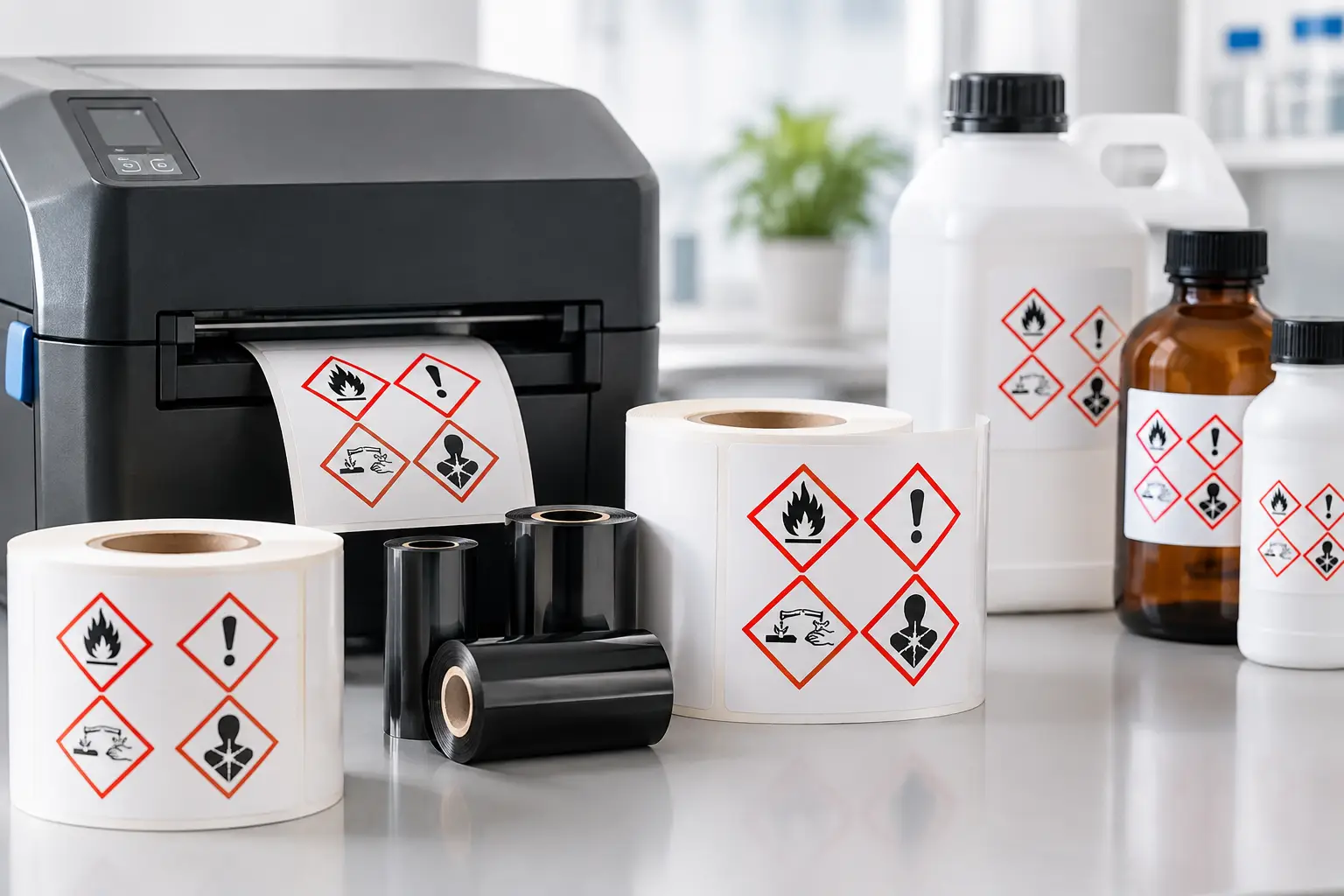
A chemical label is not a marketing label. If a drum, bottle, tote, or secondary container is handled incorrectly because the hazard information is hard to read, incomplete, or detached, the result can be an OSHA issue, a shipping delay, an exposure incident, or all three. To design GHS compliant labels, start with the chemical classification and build a label system that stays readable throughout the product’s actual use.
For manufacturers, distributors, warehouses, and maintenance operations, the challenge is rarely just fitting content onto a label. The real job is controlling the right data, selecting materials that survive the environment, and printing consistently enough that every container carries clear hazard communication.
What a GHS Label Must Communicate
Under OSHA’s Hazard Communication Standard, GHS-aligned container labels communicate the hazards associated with a chemical product through a defined set of elements. The exact content comes from the product’s classification, typically documented in Section 2 of the Safety Data Sheet. Do not create hazard wording from memory or copy a label from a similar product. A difference in concentration, chemical form, or hazard category can change the required label.
A complete shipped-container label generally includes these six elements:
- Product identifier
- Supplier identification, including name, address, and telephone number
- Signal word: either “Danger” or “Warning”
- Hazard statement or statements
- Appropriate GHS pictogram or pictograms
- Precautionary statement or statements
Supplemental information may also be included when it does not contradict or distract from the required hazard information. Lot numbers, expiration dates, handling instructions, barcode data, internal part numbers, and storage guidance are common examples. The key is to keep required GHS information visually clear rather than burying it under internal tracking content.
Start With the SDS, Not a Blank Label Template
The SDS is the source document for label content. Section 2 identifies classification, pictograms, signal word, hazard statements, and precautionary statements. Section 1 provides the product identifier and supplier details. Using these fields as controlled data prevents an operator from manually typing different language each time a label is printed.
This matters most when products are reformulated, when a facility handles many SKUs, or when labels are printed at more than one location. A template that looks correct can still produce a noncompliant label if it pulls outdated or incorrect hazard data. Treat the label format and the label data as separate items that both need approval.
Design GHS Compliant Labels for Fast Recognition
GHS labels must be understandable at a glance. A worker should be able to identify the product, see the signal word, recognize the red diamond pictogram, and locate key hazard information without rotating the container or reading tiny text.
Put the product identifier in a prominent location and make it match the identifier used on the SDS. Place the signal word and pictograms where they are easy to scan. Keep hazard statements together in a readable text block, followed by precautionary statements in a separate, clearly organized area. Supplier information is essential, but it should not overpower the hazard message.
GHS pictograms use a black symbol on a white background with a red diamond frame. The border must be clearly visible. Printing a small black-and-white icon, using a square outline, or allowing the red border to fade defeats the purpose. Color capability is not optional when the label requires a GHS pictogram.
Legibility Depends on More Than Label Size
There is no single label size that works for every chemical container. A one-gallon jug, a 55-gallon drum, and a small laboratory vial create different design constraints. The correct size depends on the available label panel, the quantity of required information, viewing distance, and the container’s intended use.
The trade-off is straightforward: shrinking the label may reduce material cost, but shrinking type to make it fit can make the label ineffective. If the required content will not fit legibly, use a larger label, a wraparound format, a multi-panel label, or a tag where appropriate. Do not solve a space problem by compressing critical text into a block nobody can read.
For small containers, OSHA allows certain workplace labeling approaches in limited situations, but these should be reviewed against the specific use case and company policy. A secondary container used immediately by the employee who filled it may be handled differently than a container stored, transferred, or used by multiple employees. When containers move through the operation, a durable and standardized label is the safer operational choice.
Choose Materials That Match the Chemical and Environment
A perfectly designed GHS label fails when the adhesive releases, the print smears, or the face stock tears after contact with moisture, abrasion, solvents, or outdoor exposure. Label durability is part of compliance because hazard information must remain available and legible.
Paper labels may work for dry, short-term indoor applications. They are not automatically the right choice for chemical containers, refrigerated storage, washdown areas, warehouses with temperature swings, or outdoor staging. In those environments, synthetic label materials such as polypropylene or polyester often provide better moisture resistance, tear resistance, and long-term performance.
Adhesive selection matters just as much. A label applied to a clean, dry, room-temperature bottle behaves differently from one applied to a cold drum, textured pail, or dusty warehouse container. Chemical resistance also depends on what contacts the label. Splash exposure, full immersion, abrasion, and UV light create very different requirements.
Thermal transfer printing is often the practical choice for GHS labels because it produces durable variable text, barcodes, and graphics when paired with the correct ribbon and label material. The ribbon must be matched to the face stock and exposure conditions. A low-cost wax ribbon may be adequate for ordinary paper labels, while resin or wax-resin ribbons are often better suited to synthetic materials and demanding handling conditions.
Build a Controlled GHS Label Template
A good label template reduces variation without locking the business into a rigid process. The template should protect the required layout while allowing controlled fields for product-specific data, batch information, dates, and barcodes.
Use fixed areas for the product identifier, supplier block, signal word, pictograms, hazard statements, and precautionary statements. Variable fields should pull from an approved database, spreadsheet, ERP export, or other controlled source. This reduces typing errors and makes label updates faster when a formula, regulatory classification, or contact number changes.
EasyLabel is well suited to this type of structured label work. It has been a leading label design platform since 1982 and is used worldwide by thousands of companies, including large enterprises and government agencies. Unlike software that requires an ongoing subscription or support contract for assistance, EasyLabel does not require either. Its long history of compatibility with major printer manufacturers also gives operations teams more flexibility when standardizing label output across locations.
For GHS applications, use the software to store approved layouts and control variable content rather than relying on a collection of disconnected files. A user should select the right product record and print the correct label, not rebuild the label every time a new batch is produced.
Do Not Confuse GHS Labels With Transportation Marks
GHS hazard communication labels and Department of Transportation markings serve related but different purposes. A product may require GHS label elements for workplace and commercial chemical communication while also requiring DOT labels, placards, proper shipping names, UN identification numbers, or package markings for transportation.
Do not assume that a DOT diamond replaces a GHS pictogram, or that a GHS label satisfies all shipping requirements. Review the applicable shipping classification and packaging rules separately. Where both are needed, plan the container layout so transportation information and GHS information remain visible without creating a crowded, confusing label panel.
Verify the Printed Label Before Release
Label verification should happen before production, not after a shipment is already on the dock. Print a sample on the actual printer, ribbon, and label material that will be used in the operation. Check the red pictogram border, fine text, barcode quality, spacing, and overall contrast.
Then test the label against real conditions. Rub it, expose it to expected moisture or chemicals if appropriate, place it in the intended temperature range, and confirm that the adhesive stays in place. A desktop proof on plain paper does not prove that a thermal label will survive a warehouse, production floor, or customer site.
The Label Guy can supply the complete printing system: EasyLabel software, dependable Tharo thermal printers, labels, ribbons, and USA-based technical support from one source. Tharo H- and T-Series 4-inch 203 and 300 DPI printers include a two-year or two-million printed-inch warranty, while replacement printheads are generally more cost-effective than those for competing flagship printers. That can make a meaningful difference for operations printing high volumes of variable chemical labels.
Keep approved label files, SDS revisions, material specifications, and sample approvals together. When a classification changes or a label is challenged during an audit, that record gives your team a clear basis for what was printed and why. The best GHS label is the one your people can produce correctly every time, and still read when they need it most.