
Compliance Labeling for Hazardous Materials
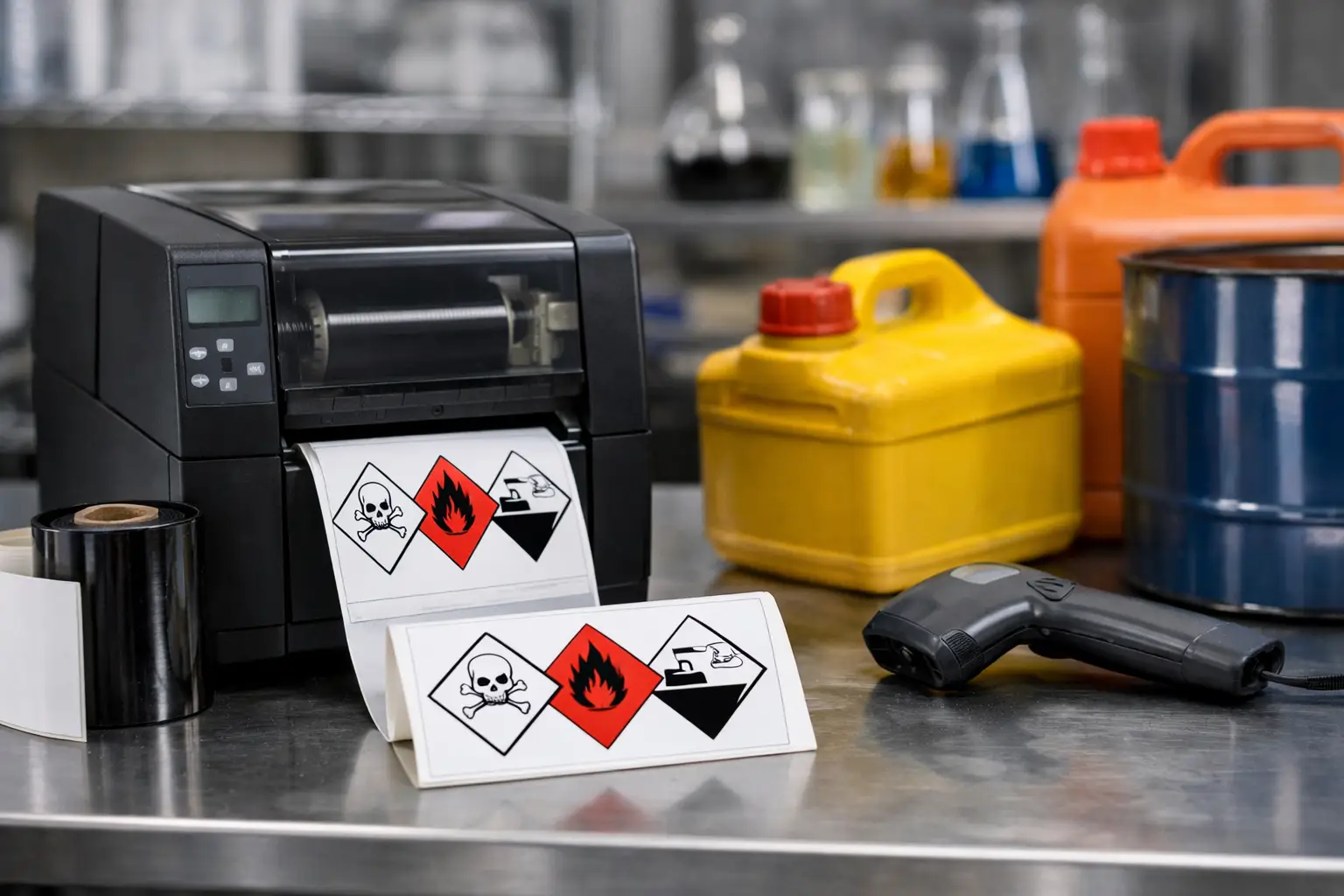
A hazardous-material label is often the first piece of information a worker, carrier, inspector, or emergency responder sees. If it is missing, unreadable, applied to the wrong container, or based on outdated data, the consequences can extend well beyond a failed inspection. Delayed shipments, rejected loads, employee exposure, product holds, and avoidable rework can all start with a label that was treated as an afterthought. Effective compliance labeling for hazardous materials is a controlled operational process, not simply a print job.
For manufacturers, warehouses, distributors, and logistics teams, the challenge is managing changing requirements while producing labels that remain legible through handling, storage, transport, and use. The right labeling system gives your team a repeatable way to turn approved hazard data into dependable physical identification.
What Compliance Labeling Must Accomplish
Hazardous-material labeling is governed by the context in which the material is used and moved. A chemical stored and used in a workplace may require communication under OSHA’s Hazard Communication Standard. A package entering transportation may fall under Department of Transportation requirements. Other obligations can arise through EPA rules, state programs, customer specifications, or international shipping standards.
Those requirements overlap in purpose, but they are not interchangeable. A workplace container label does not automatically satisfy transport requirements, and a transport marking is not necessarily sufficient for employee hazard communication. The first practical rule is to identify the material, the container type, and the point in its lifecycle where the label will be used.
A compliant label may need to communicate a product identifier, supplier information, signal word, hazard statements, precautionary statements, pictograms, identification numbers, proper shipping names, hazard classes, handling instructions, or other required markings. The exact content depends on the regulation, material, package, and shipment. Guessing from a previous label template is not a compliance strategy.
Your safety data sheet, approved regulatory data, and internal compliance process should determine the label content. Label software and printers make that information usable at the point of work. They do not replace the responsibility to verify that the approved information is correct.
Compliance Labeling for Hazardous Materials Starts With Control
The most reliable operations separate label approval from label production. Compliance, safety, quality, or product stewardship teams establish the approved language, symbols, and layouts. Operations teams print from those controlled formats without manually rebuilding labels every time a drum, tote, bottle, carton, or shipment needs identification.
This approach reduces a common source of error: an employee opening an old file, changing a few fields, and unknowingly printing a label with obsolete hazard text or the wrong pictogram. Controlled templates also make it easier to keep consistent label sizes, colors, barcode placement, and human-readable text across multiple facilities or shifts.
A workable process should define who can create or revise a hazardous-material label format, who approves the revision, where the approved version is stored, and how retired versions are removed from use. It should also establish how variable data – such as lot number, fill date, net quantity, or destination information – is entered and verified.
This does not need to become an unnecessarily complicated system. It does need clear ownership. A simple, documented approval path is far safer than relying on tribal knowledge and shared desktop files.
Build templates around the container and environment
Label design is not only about fitting required content onto a rectangle. The label must work on the actual package. A small secondary container may require a different format than a 55-gallon drum. A curved bottle, rough corrugated carton, plastic tote, steel pail, or flexible bag each creates different adhesion and durability demands.
Start with the usable label area, then allocate space for mandatory information before adding internal details. Keep critical warnings prominent and readable at the expected viewing distance. Avoid shrinking required text until it is technically present but practically unusable. Where a barcode is required for internal traceability, test it after printing and after normal handling rather than assuming it will scan because it looked clear on screen.
Choose Materials That Survive the Job
A correct label that smears, peels, fades, or tears is no longer doing its job. Material selection matters as much as the content, particularly when labels face moisture, abrasion, chemical contact, UV exposure, refrigeration, outdoor storage, or repeated handling.
Direct thermal labels can be useful for short-life applications, but they are often a poor fit where heat, sunlight, friction, or long-term storage can darken or fade the image. Thermal transfer printing is generally the stronger choice for durable hazardous-material identification because the ribbon and label material can be matched to the application.
The label face stock, adhesive, and ribbon must be considered together. A paper label may be acceptable for a protected indoor carton. Synthetic materials are usually better suited for drums, chemical containers, and warehouse environments where moisture and abrasion are expected. Adhesive performance also depends on the surface condition and application temperature. A label applied to dusty, oily, cold, or heavily textured surfaces may fail even when the label stock itself is high quality.
Before standardizing, test labels on representative containers under real conditions. Check adhesion after curing time, print legibility after handling, and barcode performance after exposure. This small validation step is far less expensive than relabeling inventory or holding a shipment because labels did not stay attached.
Match Software, Printer, and Supplies
Hazardous-material labeling becomes less dependable when software, printers, ribbons, and labels are selected independently. The operation may save money on one component, then lose it in printhead wear, poor print quality, ribbon mismatch, frequent setup changes, or support delays.
A thermal transfer printer should provide the print width, resolution, duty capability, and media handling your label formats require. Four-inch industrial printers are suitable for many drum, carton, and warehouse applications. Wider labels or highly detailed content may call for a wider print engine or higher resolution. The answer depends on label size, print volume, required text size, and whether you are printing dense barcodes or fine graphics.
EasyLabel is a practical fit for organizations that need controlled label formats without being forced into an ongoing software subscription or support contract. It has been a leading label design platform since 1982 and is used by thousands of companies worldwide, including large enterprises and government agencies. Its established compatibility with major printer manufacturers is valuable when your operation has existing equipment or expects to standardize across locations.
For businesses purchasing a Tharo printer with EasyLabel, the benefit is straightforward: one USA-based support contact can help address the software and printer workflow together. Tharo printers can also be a cost-effective alternative to flagship models from larger brands, with replacement printheads that are generally less expensive. Their H- and T-Series four-inch 203 and 300 DPI models carry a two-year or two-million-printed-inch warranty, giving buyers meaningful protection in demanding operations.
The Label Guy can supply the software, printer, labels, ribbons, and technical guidance as one coordinated system. That matters when a compliance label needs to print consistently on the first shift, the third shift, and at another facility using the same approved format.
Common Failure Points to Eliminate
Most labeling failures are predictable. They occur when a process relies on memory, a label is treated as a generic consumable, or an approved format is bypassed under time pressure. Pay close attention to these recurring issues:
- Using a workplace label for a transport package, or the reverse, without confirming the applicable requirements.
- Printing from old files after a formula, classification, supplier address, or shipping description has changed.
- Selecting label stock and ribbon based on purchase price instead of exposure conditions and required service life.
- Applying labels over dirt, moisture, seams, or uneven surfaces where adhesion is likely to fail.
- Allowing uncontrolled edits to hazard text, pictograms, or label layouts at the production floor.
The corrective action is usually process discipline, not a dramatic technology change. Establish approved templates, train operators on the intended workflow, keep the right consumables in stock, and inspect printed labels before they enter use. For high-risk or high-volume applications, periodic audits should confirm that labels still match current documentation and remain readable in the field.
Make Replenishment Part of Compliance
A labeling program can fail simply because the correct ribbon or label material is unavailable when production needs it. Teams then substitute whatever is on hand, print at lower quality, or postpone relabeling. Those workarounds create unnecessary exposure.
Set minimum inventory levels for approved label stocks and ribbons, especially for critical container sizes and emergency response materials. Record the printer settings that produce acceptable results for each approved format. When changing a ribbon, label material, printhead, or printer model, run a short verification test before returning the format to production.
The best time to solve a hazardous-material labeling problem is before a container reaches the dock or a worker reaches for it. Treat every label as a durable, controlled instruction at the point where safe handling and compliant movement depend on it.