
Wax Versus Resin Ribbons for Industrial Labels
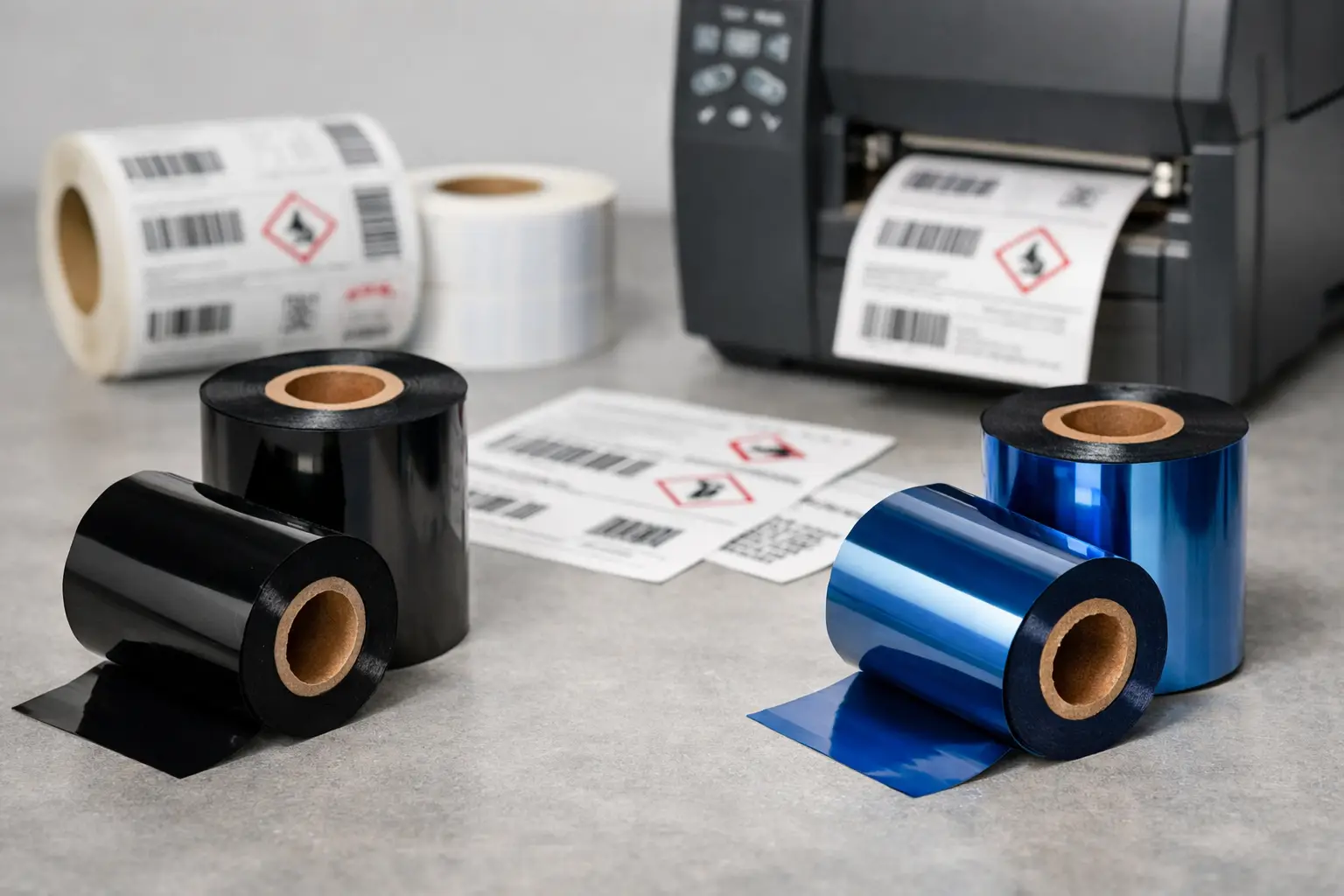
A barcode that scans perfectly when it leaves the printer can become an operational problem after a few trips through a warehouse, exposure to a cleaning agent, or repeated handling on the production floor. That is why the choice between wax versus resin ribbons should be based on the label’s real working conditions, not simply on the lowest ribbon price.
Thermal transfer ribbon is the ink layer that a thermal transfer printer melts onto a label. The formulation determines how well the printed image resists rubbing, moisture, chemicals, heat, and abrasion. Wax ribbons, resin ribbons, and wax-resin blends each have a place in a dependable labeling program. The right choice protects barcode readability, avoids unnecessary supply costs, and helps prevent relabeling work later.
Wax Versus Resin Ribbons: The Core Difference
Wax ribbon uses a wax-based ink formulation that transfers at relatively low print energy. It is the most common and economical thermal transfer ribbon type. Wax works particularly well on paper labels, including uncoated and coated paper stocks used for shipping, inventory, retail, and general-purpose identification.
Resin ribbon uses a harder, more durable ink formulation. It generally requires higher print energy and performs best with synthetic label materials such as polypropylene, polyester, vinyl, and other film facestocks. Once properly matched to the label, resin printing delivers much stronger resistance to smudging, scratching, chemicals, moisture, and environmental exposure.
The practical distinction is simple: wax is usually selected for labels with a shorter useful life and moderate handling, while resin is selected when the printed image must remain legible under difficult conditions. That does not make resin the automatic premium choice for every application. Using a resin ribbon on a basic paper shipping label may increase cost without delivering a useful operational benefit.
Between the two is wax-resin ribbon. This hybrid formulation provides better durability than standard wax while remaining more economical than full resin. It is often a strong fit for coated paper and some synthetic materials when labels need improved rub resistance but will not face aggressive chemicals or long-term outdoor exposure.
Start With the Label Material
Ribbon and label material must be treated as a matched system. A ribbon that performs well on one facestock may print poorly or fail prematurely on another.
Paper labels are usually the natural territory of wax ribbons. Direct thermal or thermal transfer shipping labels, warehouse rack labels, carton identification labels, and short-term inventory labels commonly use paper because it is cost-effective and easy to print. A quality wax ribbon can create dark, scannable barcodes and readable text at efficient print speeds.
Coated paper offers a smoother surface and can improve print definition, but its surface may require a wax-resin ribbon for stronger adhesion and better resistance to scuffing. For example, a glossy product label that will be handled throughout distribution may benefit from wax-resin rather than basic wax.
Synthetic labels demand a closer look. Polypropylene, polyester, and vinyl are chosen because they can withstand moisture, tearing, temperature variation, and demanding handling. A durable facestock does not provide much value if the barcode or lot number rubs away. Resin ribbon is generally the appropriate choice for these applications because it bonds more effectively to synthetic surfaces.
Before standardizing on any combination, test the actual label stock, printer, ribbon, and application conditions together. Material names alone are not enough. Coatings, topcoats, adhesive systems, and printer settings can all affect the final result.
When Wax Ribbon Is the Smart Business Choice
Wax ribbon is not the budget compromise when the application is right. It is an efficient choice for high-volume operations where labels are used indoors, handled normally, and replaced or discarded within a short period.
Common wax ribbon applications include shipping and receiving labels, corrugated case labels, warehouse picking labels, retail price labels, document tracking labels, and standard inventory identification. These labels need crisp text and dependable barcode scanning, but they typically do not need to survive solvents, outdoor weather, or repeated abrasion.
Wax ribbons also support faster, lower-energy printing in many configurations. That can help operations maintain throughput while reducing wear associated with unnecessarily high heat settings. For businesses printing thousands of labels per shift, the combination of reasonable ribbon cost, print speed, and reliable scan performance can make wax the clear operational choice.
There are limits. Wax printed images can scratch, smear, or transfer when exposed to friction, moisture, oils, and certain chemicals. If labels will move through conveyor systems, be handled frequently, or remain in service for extended periods, standard wax may create avoidable barcode failures.
When Resin Ribbon Earns Its Higher Cost
Resin ribbon is designed for applications where label durability is a requirement rather than a preference. It is commonly used for asset tags, product identification, laboratory labels, chemical container labels, medical device labeling, electronics identification, outdoor equipment labels, and compliance-oriented applications.
Its primary advantage is resistance. A properly printed resin image can withstand conditions that quickly damage wax printing, including repeated contact, damp environments, cleaning agents, oils, and exposure to temperature changes. The exact level of resistance depends on the particular ribbon and label material, so claims should always be verified through application testing.
Resin is especially valuable when a failed label creates more than a scanning inconvenience. An unreadable serial number can interrupt asset tracking. A compromised lot code can complicate traceability. A damaged chemical label can create a compliance and safety concern. In those situations, the additional ribbon cost is small compared with the cost of manual correction, delayed shipments, rejected product, or lost identification.
Resin printing also requires attention to printer setup. Higher heat is often necessary to transfer the ribbon correctly, but excessive heat can blur fine barcode elements, damage certain label surfaces, or shorten printhead life. Print darkness, speed, pressure, and ribbon compatibility should be set for the specific media combination rather than copied from a generic printer profile.
Evaluate the Actual Label Environment
The label’s environment should drive the decision. Ask what happens after the label leaves the printer. Will it be applied to a clean carton and scanned once? Will it remain on a tote circulating through a warehouse? Will it encounter freezer storage, oils, alcohol wipes, UV exposure, or abrasive contact?
A useful evaluation includes the following four conditions:
- Handling: Consider rubbing against other packages, conveyor contact, picking activity, and frequent scanning.
- Exposure: Identify water, humidity, chemicals, oils, cleaning products, heat, cold, and sunlight.
- Required service life: Determine whether the label is needed for one shipment, several months, or the life of an asset.
- Barcode consequence: Define what happens if the code cannot be scanned. A low-risk internal label and a traceability label should not be specified the same way.
This approach often reveals that different departments need different ribbon grades. Shipping may use wax on paper labels, while maintenance uses resin on polyester asset tags. A single ribbon type across every application may simplify purchasing, but it can also increase cost or reduce performance.
Print Quality Depends on More Than Ribbon Chemistry
A ribbon selection cannot correct a worn printhead, poorly calibrated printer, or unsuitable label design. Narrow barcodes, very small text, dense graphics, and high-speed printing all demand closer control of the thermal transfer process.
Start with a clean printhead and a ribbon width that fully covers the label image area. Ribbon that is too narrow can allow direct contact between the printhead and label, increasing wear. Use the printer’s media calibration procedures and adjust darkness only as needed to produce a sharp image. Darker is not always better. Excessive heat can cause bar spread, which may make a barcode look bold while reducing its ability to scan.
Verification should also extend beyond visual appearance. Scan test labels with the scanners used in the operation, then perform practical rub, scratch, moisture, or chemical-resistance tests that reflect the label’s intended use. For critical applications, document the approved printer, label, ribbon, and settings so operators can reproduce the result consistently.
Choosing the Right Ribbon for a Reliable Labeling System
The best ribbon decision balances performance with total operating cost. Wax usually delivers the right result for short-life paper labels in controlled indoor settings. Wax-resin provides a useful middle ground for applications needing better image durability. Resin is the preferred option when synthetic labels and demanding conditions require lasting identification.
The Label Guy helps businesses evaluate the complete thermal transfer setup, including printer capability, label material, ribbon formulation, and the conditions the finished label must survive. That systems-level view is more dependable than selecting supplies one item at a time.
A ribbon should be judged by the label that still scans when the work is done, not only by the label that looks good at the printer.