
Top Label Materials for Chemicals That Last
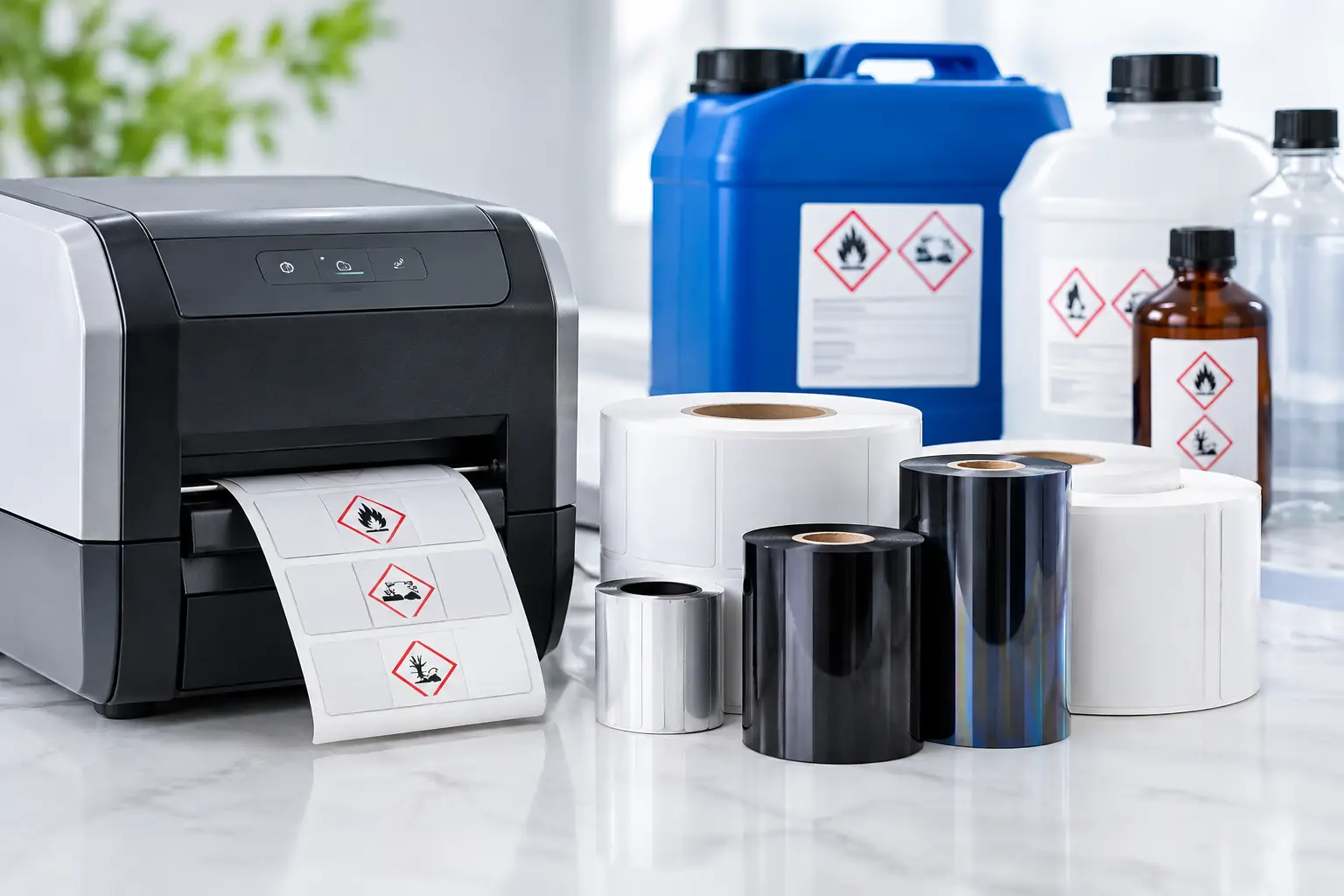
A chemical label can look perfect when it leaves the printer and still fail before the container reaches the production floor. Solvent splash, drum handling, humidity, cold storage, outdoor exposure, and repeated abrasion all test the label stock, adhesive, ribbon, and print method at once. Selecting the top label materials for chemicals means matching the entire construction to the product, container, and conditions it will actually face.
For chemical manufacturers, distributors, laboratories, and warehouse operations, readability is more than a presentation issue. Hazard communication details, batch numbers, product names, handling instructions, and barcodes must remain legible when employees need them. A low-cost paper label that smears or lifts can create avoidable compliance exposure, inventory errors, and relabeling labor.
What Makes a Chemical Label Durable?
Chemical resistance is not a single material property. A label may withstand water but soften when exposed to alcohols. It may resist a mild cleaning agent yet fail when petroleum-based oils reach the adhesive edge. The right choice depends on the chemical being packaged, whether exposure is occasional or continuous, and whether the label must survive the full product lifecycle.
Start by considering four practical factors: the container surface, the chemical exposure, the environmental conditions, and the required service life. High-density polyethylene bottles, steel drums, glass containers, and corrugated secondary packaging all present different adhesion challenges. A label applied to a clean, smooth bottle in a climate-controlled room has very different needs than one applied to a textured drum stored outdoors.
Print durability matters just as much as facestock selection. Direct thermal printing is useful for short-lived shipping and handling labels, but heat, sunlight, abrasion, and many chemical environments can darken or fade the image. For durable chemical identification, thermal transfer printing with a compatible resin ribbon is typically the better choice. The ribbon formulation must be tested with the selected label material and the expected exposure.
Top Label Materials for Chemicals by Application
Polyester for demanding chemical and industrial use
Polyester is often the first material to consider when labels must remain intact and readable in demanding industrial conditions. This film provides excellent resistance to moisture, tearing, abrasion, and many common chemicals. It also holds fine thermal transfer print well, making it a strong choice for barcodes, small text, serialized identification, and detailed safety information.
Polyester labels are widely used on chemical containers, laboratory bottles, equipment, drums, and asset tags. White polyester supports clear high-contrast printing, while clear polyester can work where the package design must remain visible. For applications involving frequent handling, cleaning, or exposure to oils and solvents, polyester paired with a resin ribbon is a dependable starting point.
The trade-off is cost. Polyester generally costs more than paper or basic polypropylene, but the expense is often small compared with the cost of relabeling containers, correcting barcode scans, or replacing information that has become unreadable.
Polypropylene for moisture and moderate chemical exposure
Polypropylene is a practical synthetic label material for many chemical packaging applications. It is water resistant, flexible, and more economical than polyester in many formats. It performs well on bottles and containers that may encounter moisture, splashing, condensation, and routine handling.
For cleaners, detergents, personal care chemicals, agricultural products, and other packaged liquids with moderate exposure requirements, polypropylene may provide the right balance of performance and cost. It is also a useful option when the label needs to conform around a curved container.
However, polypropylene is not automatically the right answer for aggressive solvents, extended outdoor exposure, or heavy abrasion. In those cases, polyester or a more specialized construction is usually the safer choice. Test labels against the actual formulation, not just the general product category. Two products described as “cleaners” can have very different effects on inks, facestocks, and adhesives.
Vinyl for flexible surfaces and outdoor conditions
Vinyl is valued for flexibility and conformability. It can be a strong option for curved, uneven, or flexible surfaces, including certain drums, containers, and equipment. Depending on the construction, vinyl can also provide good water resistance and outdoor durability.
A vinyl label may be appropriate when a rigid film would wrinkle or lift around curves. Its flexibility is useful, but it does not remove the need to select the proper adhesive and ribbon. Chemical contact at the edge of the label can still undermine adhesion, particularly on low-energy plastics or surfaces with residue.
Paper labels for controlled, short-term needs
Paper is not usually the preferred choice for primary chemical labels, but it has a place in controlled applications. It can be cost-effective for outer cartons, warehouse location labels, temporary work-in-process identification, and short-duration shipping labels that are not likely to see moisture or chemical contact.
The limitation is straightforward: unprotected paper can absorb moisture, tear, scuff, and deteriorate quickly. Coated paper may improve print quality and provide some added resistance, but it should not be treated as a substitute for a durable film label where chemical exposure is expected. Using paper in the wrong application often creates a false economy.
Adhesive Selection Is Part of the Label Material Decision
A high-performance film cannot compensate for an adhesive that is wrong for the container. Adhesive selection is especially important with HDPE, polypropylene, powder-coated metal, textured drums, cold containers, and surfaces that may have oil, dust, or condensation.
Permanent acrylic adhesives are common for many chemical container applications because they provide strong adhesion and good environmental performance. But application temperature matters. A label applied in a cold warehouse may need a cold-temperature adhesive, while a label placed on a container that will be stored in heat may require an adhesive designed for elevated temperatures.
Drum labels deserve special attention. Their surfaces may be curved, textured, dirty, or exposed to weather during transport and storage. A label that adheres well to a smooth sample panel may fail on a real drum. Whenever the application is high risk, request a sample and perform testing on the actual container under real storage and handling conditions.
Pair the Material With the Right Thermal Transfer Ribbon
The label is only half of the durability equation. Thermal transfer ribbons are generally available in wax, wax-resin, and resin formulations. Wax ribbons are economical and work well on many paper labels, but they offer limited chemical and abrasion resistance. Wax-resin ribbons improve durability and can be suitable for some coated papers and synthetic materials.
For most durable chemical labels, resin ribbon is the preferred option. Resin ribbons are designed to produce highly durable images on synthetic facestocks such as polyester and polypropylene. They are better suited to applications involving abrasion, moisture, solvent contact, and harsh handling.
Compatibility still needs to be confirmed. A resin ribbon that performs exceptionally on polyester may not produce the best result on a specific polypropylene film. Printhead energy settings, print speed, label coating, and the chemical exposure all affect results. A test run can prevent thousands of labels from being produced with a barcode that later smears or fails to scan.
Consider Regulatory Content Before Choosing Label Size
Chemical labels often need to carry significant information in limited space. Hazard statements, pictograms, signal words, precautionary language, supplier information, lot details, and barcodes can quickly make a small label crowded. Material selection should be considered alongside label size and print resolution.
A durable material with poor print clarity does not solve the problem. Fine text and small barcode symbologies require a stable print process and sufficient resolution. A 300 DPI thermal transfer printer is often beneficial when chemical labels include dense text or smaller barcode elements. For larger drum labels with standard text, 203 DPI may be sufficient, depending on the required barcode size and scanning distance.
Do not reduce label size merely to save material. If critical information becomes difficult to read, the savings disappear quickly. In some cases, a larger primary label, a secondary informational label, or a wraparound format is the more workable approach.
Build a Chemical Labeling System, Not a One-Time Purchase
Material choice works best when it is part of a complete labeling workflow. The printer, ribbon, label format, software, and support process should work together so teams can produce consistent labels without recreating designs or guessing at printer settings.
EasyLabel has been a leading label design platform since 1982 and gives operations a practical way to create chemical identification, barcode, and variable-data labels without requiring a subscription or support contract. When paired with a Tharo thermal transfer printer, businesses can source a cost-effective printer, compatible labels and ribbons, and USA-based support through one specialist. Tharo H-Series and T-Series 4-inch 203 and 300 DPI printers also include a two-year or two-million-printed-inch warranty, while replacement printheads are generally less expensive than those for flagship competitor models.
The Label Guy can help match label materials, adhesives, ribbons, printer capability, and software needs before a large order is placed. That is particularly valuable when an application involves aggressive products, challenging container surfaces, or a label that must stay readable for months or years. Orders over $100 also qualify for free ground shipping within the 48 contiguous United States.
Before committing to a material, test a representative printed label on the real package, expose it to actual chemicals and conditions, and scan the barcode after handling. That simple step is often the difference between a label that merely looks right and one that keeps working when it matters.