
Label Material Selection Guide for Business Use
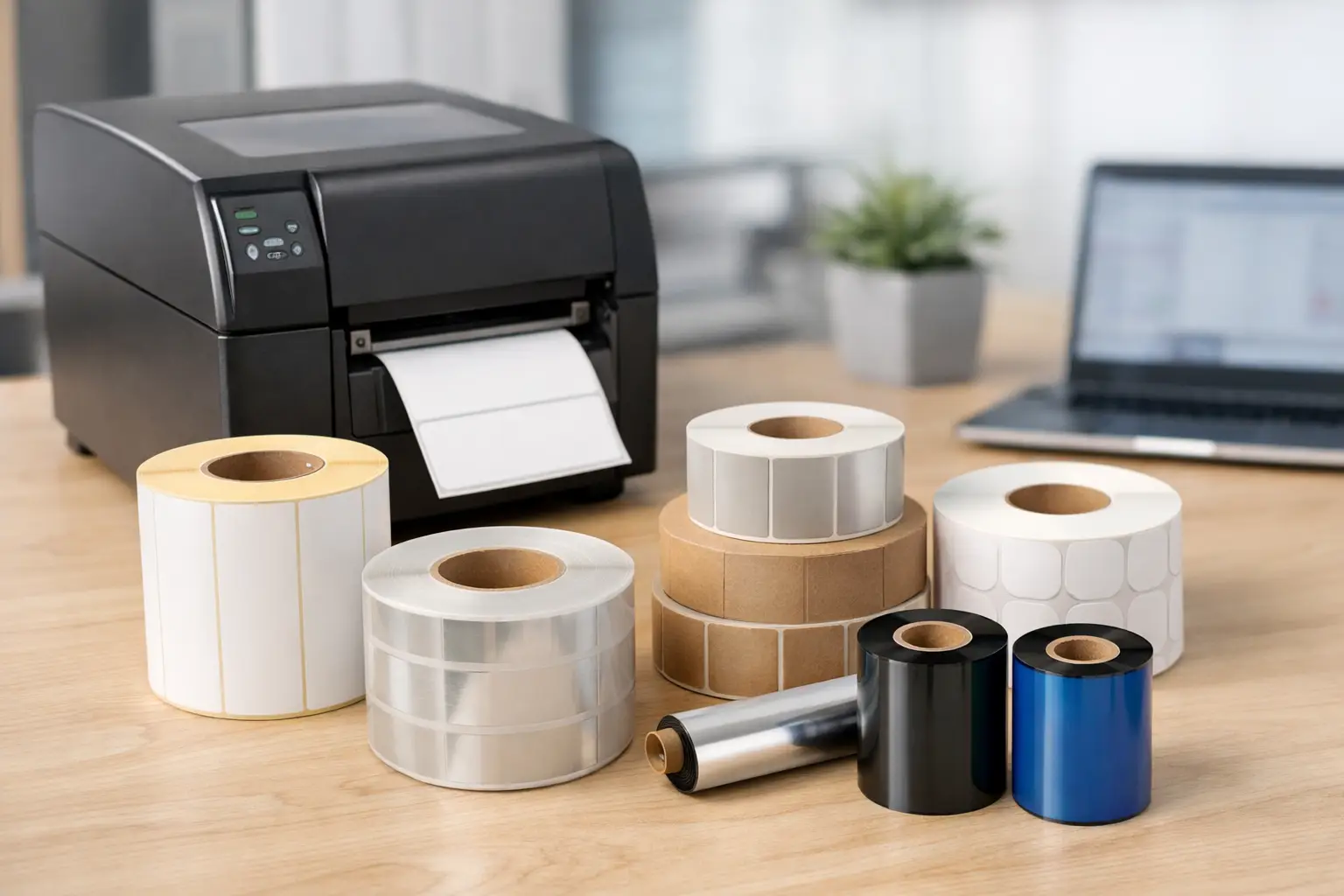
A barcode label that scans perfectly on the packing line can still fail before the shipment reaches its destination. Adhesive can release in a cold warehouse, a paper face can tear during handling, or a printed image can smear when it meets oil or cleaning chemicals. This label material selection guide starts where reliable labeling decisions should start: with the actual conditions the label must survive.
Start the Label Material Selection Guide With the Application
Do not choose a label material based on appearance alone. Begin by defining what the label identifies, where it will be applied, how long it must remain readable, and what happens to it after application. A temporary pick label on a corrugated carton has very different requirements from a permanent asset tag, chemical drum label, medical specimen label, or outdoor equipment identifier.
Ask practical questions before specifying a facestock or adhesive. Is the surface cardboard, plastic, glass, painted metal, untreated wood, or a curved container? Will it be applied at room temperature or inside a freezer? Will the product encounter water, abrasion, oils, solvents, sunlight, or repeated handling? A label that only needs to last through a one-day shipping cycle can be economical. A label needed for years of traceability should be selected for durability first.
The application surface matters as much as the environment. Smooth, clean surfaces usually accept a broad range of adhesives. Rough corrugate, low-surface-energy plastics, textured metal, and dusty containers require a more deliberate choice. If the adhesive cannot make consistent contact with the surface, the most durable label face will not solve the problem.
Choose the Right Facestock
The facestock is the printable top layer of the label. It affects durability, print quality, appearance, and cost. Paper remains a practical choice for many indoor labeling jobs, while film materials are often justified when moisture, abrasion, chemicals, or long service life are involved.
Paper Labels for Everyday Indoor Work
Paper labels are cost-effective, print clearly, and work well for shipping, inventory, work-in-process, retail, and general product identification. Standard matte paper provides dependable barcode contrast and is a common choice for thermal transfer printing. Direct thermal paper is useful when labels have a short useful life, such as shipping labels, receipts, and temporary tracking labels.
The trade-off is durability. Paper can tear, absorb moisture, and degrade when exposed to friction or chemicals. Direct thermal images can also darken with heat, fade with prolonged light exposure, or be damaged by contact with certain materials. It is a sensible option for short-term logistics, not a default choice for permanent identification.
Film Labels for Tougher Conditions
Polypropylene, polyester, and vinyl films offer greater resistance to moisture and tearing than paper. Polypropylene is often selected for product and container labels that need a flexible, water-resistant material. Polyester is a strong fit for asset tags, equipment identification, and applications requiring excellent dimensional stability and resistance to abrasion or heat. Vinyl is useful when conformability is needed, such as curved or uneven surfaces, though it may not be the best fit for every chemical or high-temperature application.
Film labels cost more than paper, but the lower replacement rate can justify the difference. When a failed label can create a receiving error, a safety issue, a compliance problem, or a lost asset, material durability is part of the operational cost calculation.
Adhesive Selection Is Not an Afterthought
A label system has to stick before it can identify anything. Adhesive selection should account for both application temperature and service temperature. These are not the same thing. A label may need to be applied in a chilled area and then remain in frozen storage, or it may be applied at room temperature before exposure to heat outdoors.
Permanent acrylic adhesives are widely used for general-purpose labeling because they provide dependable adhesion on many surfaces. Removable adhesives are appropriate when labels must come off cleanly, such as temporary inventory labels or returnable container identification. High-tack adhesives can help with corrugate, textured materials, or difficult plastics. Freezer-grade adhesives are formulated for cold applications, while specialty adhesives may be required for oily surfaces, high heat, or chemical exposure.
Do not assume a permanent adhesive is automatically the strongest choice. Some permanent adhesives perform poorly on certain plastics, while another adhesive may bond well only after sufficient dwell time. Surface energy, cleanliness, curvature, and temperature all affect results. A label applied to a cold, wet, dusty drum has a very different adhesive challenge than one applied to a clean indoor carton.
Match the Print Method to the Material
Material selection and print technology must work together. Direct thermal printing uses heat-sensitive label stock and does not require ribbon. It simplifies supply management and can be a good choice for high-volume, short-life labels. The limitations are image durability and environmental sensitivity.
Thermal transfer printing uses a ribbon to transfer an image onto the label. It supports a broader range of paper and film materials and is generally the better choice for labels exposed to handling, storage, abrasion, moisture, chemicals, or extended service periods. It also gives operations more flexibility to choose the material based on the job rather than being restricted to direct thermal stock.
The ribbon must match the label material and the required durability. Wax ribbons are economical for many paper applications. Wax-resin ribbons provide better smudge and abrasion resistance. Resin ribbons are typically used with synthetic materials when chemical resistance, scratch resistance, and durable print are required. A premium label paired with the wrong ribbon can still produce poor print adhesion or a barcode that fails in the field.
Print resolution also deserves attention. A standard 203 dpi printer handles many shipping, warehouse, and inventory labels effectively. Smaller text, dense barcodes, detailed graphics, and compact compliance layouts may benefit from 300 dpi or 600 dpi output. Select resolution based on the smallest critical element on the label, not simply on the size of the label itself.
Consider the Whole Label Construction
Facestock, adhesive, ribbon, liner, printer settings, and label design operate as one system. Changing any one component can affect the result. For example, a thick film construction may need different sensor settings or print energy than a standard paper label. A small label with a tight-radius rewind path may require a construction that performs well in the selected printer.
Label size and shape should fit the available application area while leaving room for quiet zones around barcodes. A barcode placed too close to an edge, fold, seam, or curved section can become difficult to scan even when the print itself is sharp. If labels are applied automatically, the release liner, label spacing, and dispensing behavior must also be evaluated.
Software is part of this system as well. EasyLabel has been used for label design since 1982 and works with major printer manufacturers, helping operations create consistent barcode, shipping, product, and compliance formats without forcing a subscription or support contract. For companies standardizing a labeling workflow, dependable template control is as important as choosing the physical stock.
Test Under Real Conditions Before Committing
A sample that looks good at a desk is not a complete test. Print representative labels, apply them to actual product surfaces, and expose them to the temperatures, handling, moisture, cleaners, and storage conditions they will encounter. Check barcode readability after the test, not just immediately after printing.
For critical applications, evaluate several points: initial adhesion, adhesion after dwell time, print smudge resistance, scratch resistance, scan performance, and ease of dispensing or application. If the label is regulated, verify that text remains legible and that required symbols, warnings, and identification marks stay intact throughout the expected product life.
Testing also reveals when a less expensive construction is adequate. Not every warehouse label needs polyester and resin ribbon. Conversely, using a basic paper label for a demanding application can create repeated labor costs and traceability failures. The right specification is the one that meets the requirement reliably without overbuying material performance.
Build a Supply Plan That Protects Uptime
Once a material is approved, keep the specification consistent. Switching suppliers or substituting a similar-looking label can change adhesive behavior, caliper, liner performance, print darkness requirements, and barcode results. Document the facestock, adhesive, dimensions, core size, outside roll diameter, ribbon type, and printer settings so purchasing and operations are working from the same standard.
The Label Guy can supply the printer, EasyLabel software, labels, ribbons, and technical guidance from one specialized source, reducing the guesswork that comes from mixing components from unrelated vendors. Orders over $100 also qualify for free ground shipping within the 48 contiguous United States.
When label performance matters, send the application details before placing a large order: surface, temperature, exposure, label life, printer model, and barcode requirements. A properly matched material is not just a consumable purchase. It is a practical safeguard for accuracy, compliance, and uninterrupted operations.